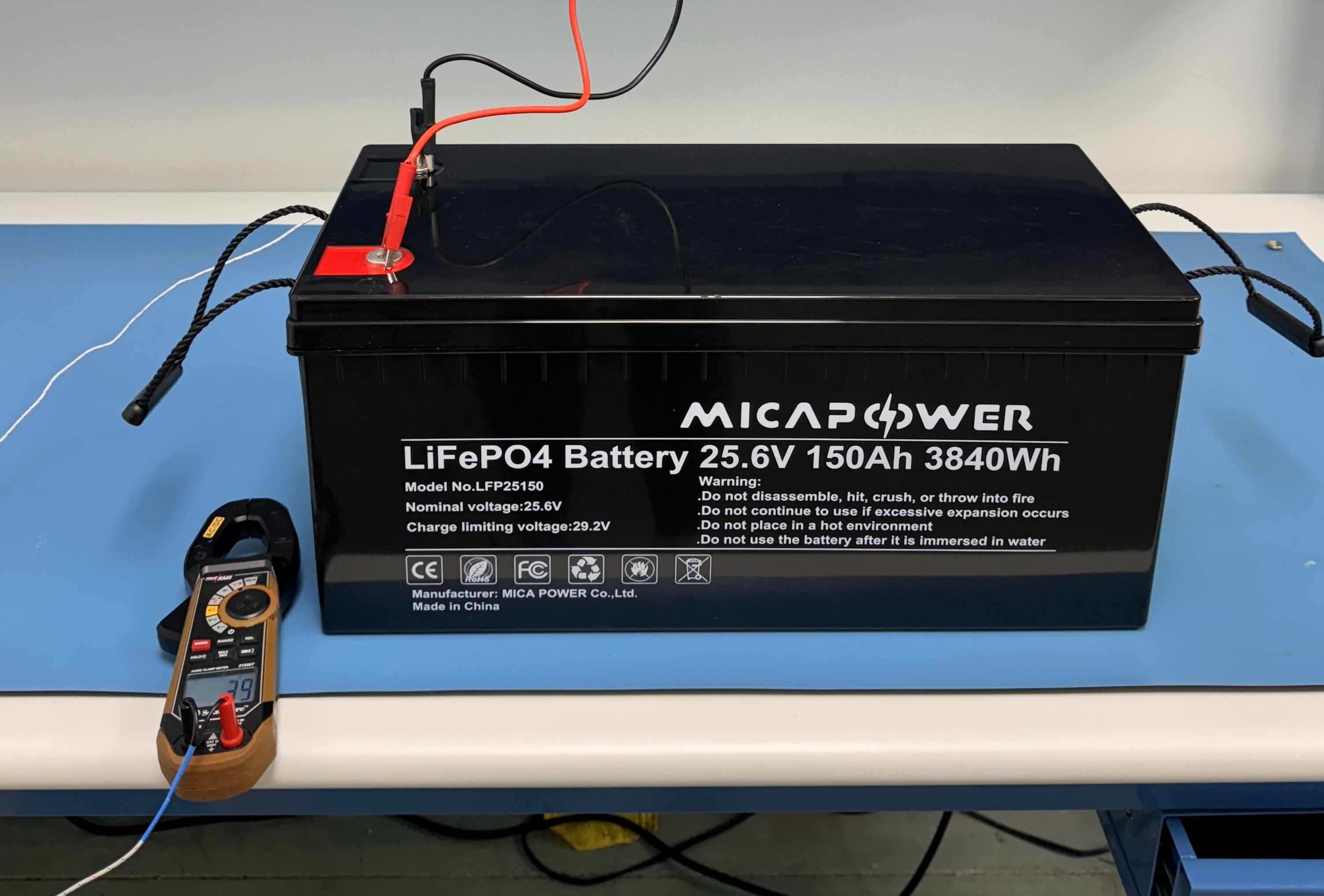
 alt="Improvised high temperature chamber built from a large LiFePO4 pack enclosure" />
Overview
PHD Energy needed to understand why some customer packs were seeing elevated terminal temperatures in the field. The obvious solution was to buy a professional environmental chamber, but that would have cost several thousand dollars and taken weeks to procure. Instead, I was asked to “see what we could do” with what we already had on hand.
I designed and built a high-temperature battery testing chamber from an empty LiFePO₄ pack enclosure, a heating pad, foam insulation, and bench-top equipment. The chamber can soak packs at controlled ambient temperatures of 45 °C and 65 °C, enabling repeatable charge/discharge tests that mirror worst-case field conditions while staying within a startup budget.
Chamber Architecture
The core design challenge was creating a safe, uniform, and controllable thermal environment inside a plastic battery enclosure not originally designed as a chamber.
- Enclosure: repurposed a large LiFePO₄ pack housing as the outer shell, giving us built-in terminals, handles, and enough volume for a module under test
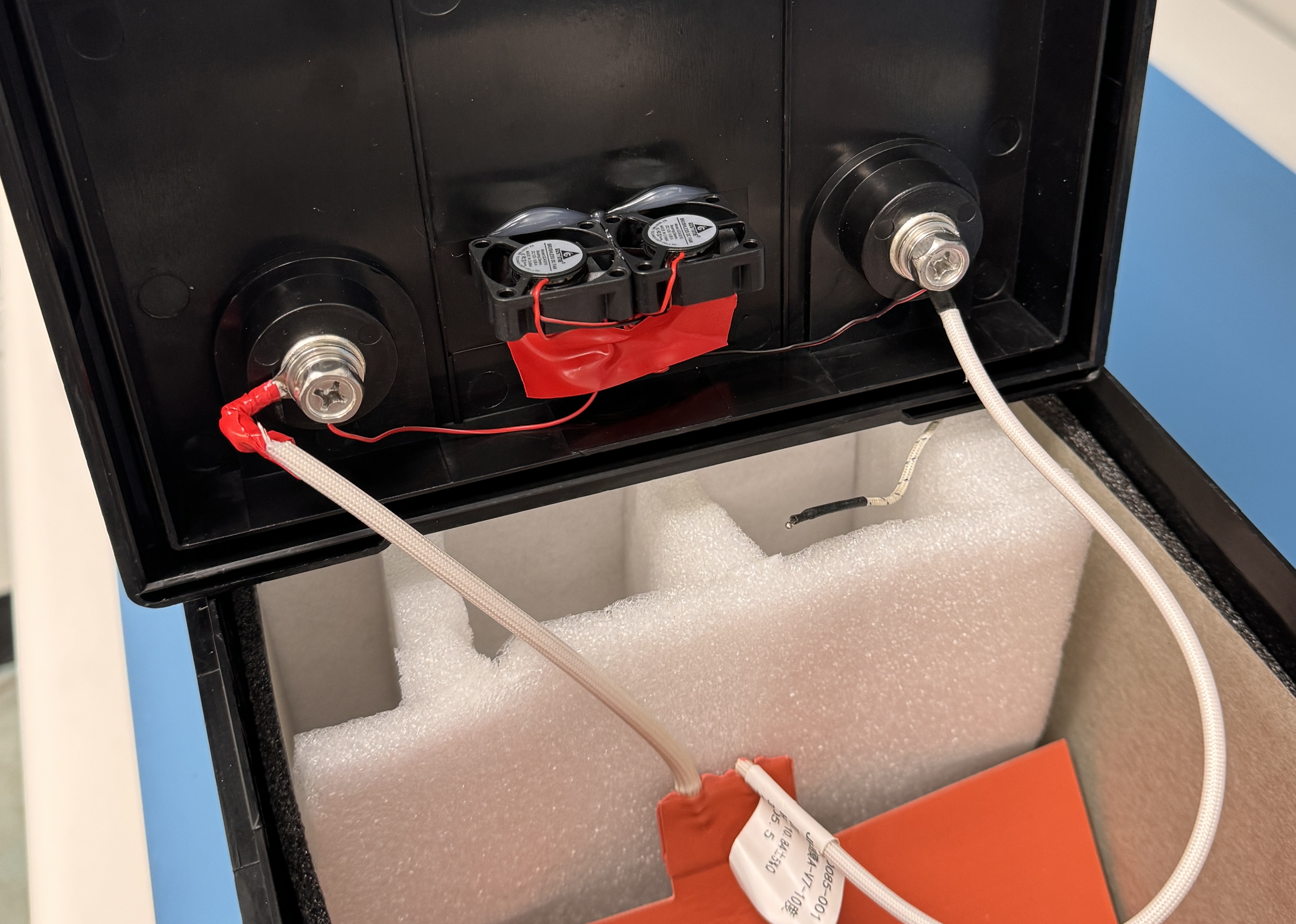
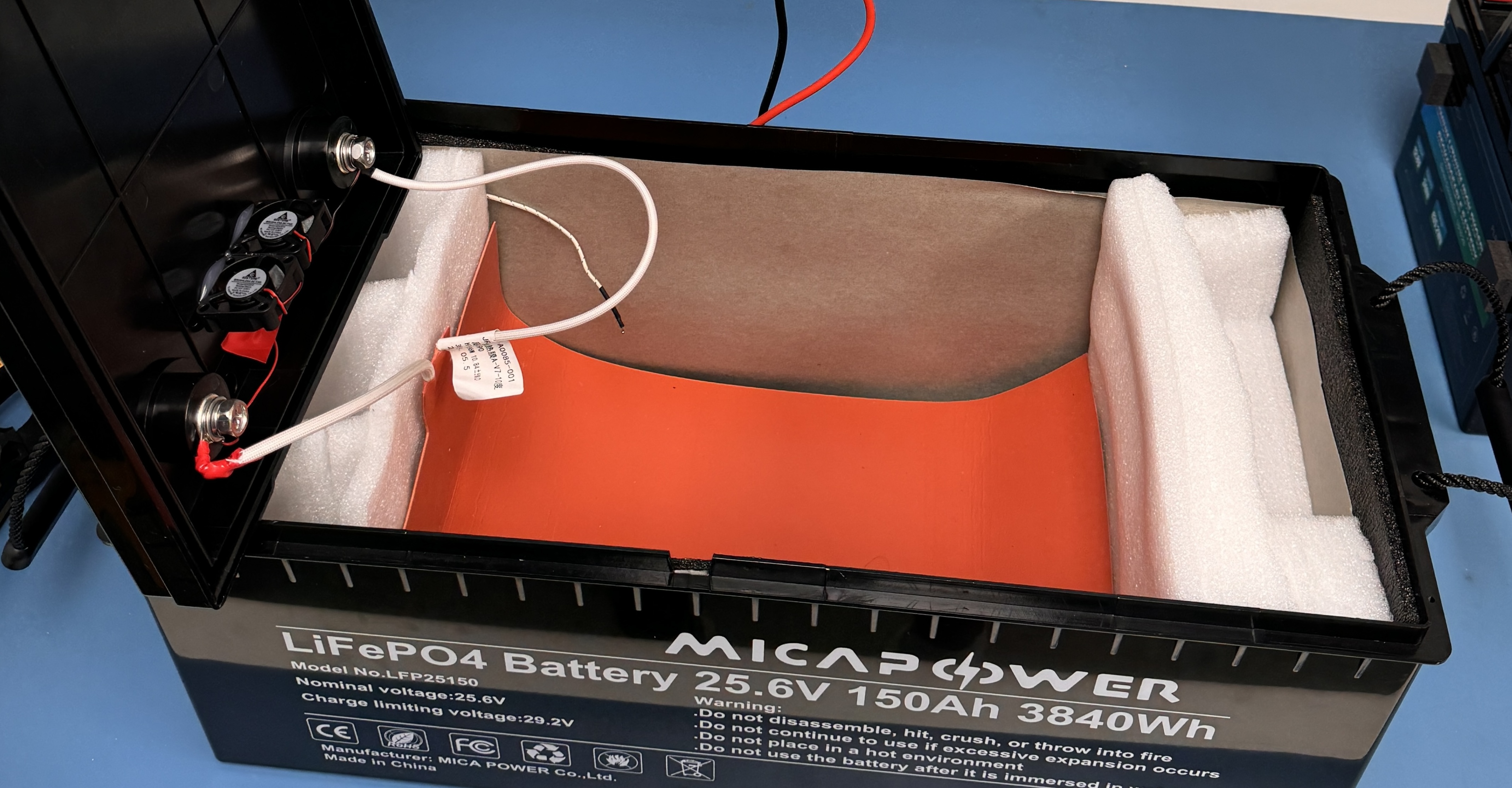
- Heating system: mounted a silicone heating pad on the steel base plate and routed its leads out through an existing strain-relief, avoiding any new penetrations that could compromise safety
- Insulation: added foam blocks and an interior liner to minimize heat loss and keep the plastic walls below damaging temperatures
- Air circulation: attached two 12 V DC fans to the inside of the lid to circulate air and reduce hot spots near the heater
- Instrumentation: ran a thermistor lead into the chamber, taped to the interior wall near the pack terminals so readings reflected the actual environment
Control & Measurement Setup
Rather than building a full PID controller, I leaned on existing lab equipment and simple procedures that technicians could repeat:
- Powered the heating pad from a bench DC supply, using voltage and current limits to cap heater power and avoid runaway.
- Used a clamp meter and multimeter to monitor heater draw and pack current during tests, verifying that our 30 A charge/discharge condition was met.
- Logged ambient chamber temperature via the thermistor and pack terminal temperatures at fixed time intervals into an Excel sheet.
- Developed a warm-up procedure: soak packs at 45 °C for 3–4 hours before starting charge/discharge cycles to ensure repeatable initial conditions.
This approach kept cost close to zero while still giving us professional-grade control over the test environment.
Validation
With the chamber built, I designed a test plan to isolate the root cause of high terminal temperatures on a 12 V LFP pack used by a robotics customer. The main variables were ambient temperature, connection method, and wire gauge.
- Soaked packs at 45 °C ambient and ran multiple charge/discharge tests at 30 A, using both alligator clips and screwed-in leads with different wire gauges
- Logged chamber and terminal temperatures over time and exported datasets into Excel for plotting and comparison
- Generated graphs comparing alligator clips vs 8 AWG and 10 AWG screwed leads for both charging and discharging, then summarized the trends and max temperatures in a client-facing report
The data showed that poor connections (alligator clips) caused significantly higher terminal temperatures than properly screwed-in leads, and that thicker wire helped but connection quality mattered most
Problems Solved & What I Learned
- Built a test chamber from scratch: turned spare parts into a safe, repeatable high-temperature chamber without buying new capital equipment
- Owned the whole pipeline: design, build, test planning, execution, data collection, and analysis all ran through me, which forced me to think about safety, repeatability, and usability at every step
- Developed reporting muscle: translated raw spreadsheets into a clear narrative report that explained the setup, showed the key graphs, and made concrete recommendations on connection hardware and wire gauge
- Learned to design within constraints: instead of specifying “ideal” equipment, I had to design a workflow that fit PHD’s existing lab, power availability, and budget
- Improved test discipline: built habits around pre-conditioning packs, documenting every configuration, and keeping enough detail that someone else can repeat the campaign months later
Impact
The improvised chamber eliminated the need to purchase a multi-thousand-dollar environmental chamber while still meeting our customer’s requirement to validate performance at elevated ambient temperatures. It enabled PHD Energy to run structured high-temperature tests on production packs, generate confident recommendations on connection hardware, and demonstrate that the root cause of high terminal temperatures was connection quality, not the cell design itself.
Just as importantly, the chamber is now a permanent tool in the lab. Future engineers can drop new packs in, follow the documented procedure, and extend validation to new products without additional capital spend.